How should automated robots be maintained on a daily basis? Robotic care wipes: a solution tailored to the high-frequency maintenance needs of production lines.

How should automated robots be maintained on a daily basis? Robotic care wipes: a solution tailored to the high-frequency maintenance needs of production lines.

With the widespread adoption of automation and intelligent manufacturing, industrial robotic arms, collaborative robots, mobile AGVs, and gantry robots have become ubiquitous on factory floors, serving as the core production assets for many manufacturing enterprises. However, many factories fall into a common trap: while investing heavily in the robots themselves, they neglect proper maintenance by using makeshift supplies—such as ordinary rags or generic, bulk-purchased cleaning agents—for upkeep. Over time, the robot’s exterior, joints, flanges, cable sheaths, and end-effectors accumulate grease, dust, cutting fluid residues, and adhesive remnants. Inadequate maintenance triggers a cascade of issues: impaired heat dissipation at the joints, obscured sensor lenses, corrosion and aging of the housing, and mechanical sticking or abnormal noises. These problems shorten the robot’s service life and increase the frequency of downtime for repairs—resulting in exorbitant maintenance costs and losses from production stoppages that place a heavy burden on factories.

Given the high frequency and numerous touchpoints involved in robot maintenance, many technicians find traditional cleaning methods both cumbersome and risky. Juneng Mechanical & Electrical Technology (Shenzhen) Co., Ltd. specializes in the cleaning and maintenance of precision industrial equipment. The company independently develops and manufactures specialized care wipes—including those for robots, adhesive removal, and equipment maintenance—offering safe, efficient cleaning solutions for sectors such as intelligent equipment, industrial manufacturing, food processing, medical devices, and specialized machinery. These products are designed as convenient, purpose-built consumables for the daily maintenance of automated equipment.

I. These robot maintenance points require daily cleaning—is your maintenance procedure keeping up?

1. Robot Body, Casing, and Joints
In a workshop environment, cutting fluids, lubricants, and dust can accumulate on the robot. Over time, these substances may seep into joint gaps, accelerating the degradation of seals—leading to oil leaks and mechanical binding. Furthermore, using standard cleaning cloths can be counterproductive; fibers may shed and become trapped within joints or along guide rails, further exacerbating wear and tear.

2. End-Effectors, Grippers, and Suction Cups
Grippers frequently come into contact with workpieces, becoming coated in oil, mold-release agents, or adhesive residue. This contamination compromises grip stability, increasing the risk of parts slipping, falling, or causing collisions—a common cause of downtime on automated production lines.

3. Lenses for Vision Cameras, Laser Sensors, and Safety Scanners
Even minor traces of oil or dust can lead to recognition errors and inaccurate positioning, triggering frequent system alarms and unplanned downtime. Because these optical components feature specialized coatings, they cannot be cleaned with harsh solvents or abrasive paper towels, as these can easily scratch the surface—resulting in high replacement costs for the sensors.

4. Power Cables, Conduits, and Cable Trays
Long-term exposure to oil and grime accelerates the aging and cracking of cable insulation, creating risks of electrical leakage or short circuits. Consequently, the cleaning and condition monitoring of cables are key priorities during electrical safety inspections in many factories.

The current reality in many manufacturing facilities is that while there is a willingness to invest in major overhauls, there is a tendency to “cut corners” on routine inspections and maintenance. Given that robots are high-value, precision equipment, the investment required for **preventive maintenance is far lower than the losses incurred from unplanned downtime or the need for factory-level repairs.** Routine cleaning represents the most cost-effective and immediate measure within a preventive maintenance strategy.
II. Why should ordinary wet wipes or cleaning agents not be used for the maintenance of industrial robots?

Common consumer-grade wet wipes and heavy-duty degreasers have significant drawbacks that make them unsuitable for the maintenance of robotic systems:

① Highly Corrosive Formulas: These can damage the paint finish on robot enclosures, as well as bellows and the PVC sheathing of cables, leading to discoloration (whitening) and cracking over time.
② Uncontrolled Liquid Saturation: Excessive liquid can seep into joints or electrical interfaces during cleaning, potentially causing short circuits or damaging drive components.
③ Coarse, Shedding Substrates: Low-cost non-woven fabrics often shed fibers, which can contaminate guide rails, bearings, or camera lenses, resulting in mechanical malfunctions or vision system errors.
④ Lack of Specialized Care: While standard products may offer basic cleaning, they lack the targeted care formulations—found in dedicated robotic maintenance wipes—that help slow the aging of rubber and plastic components.

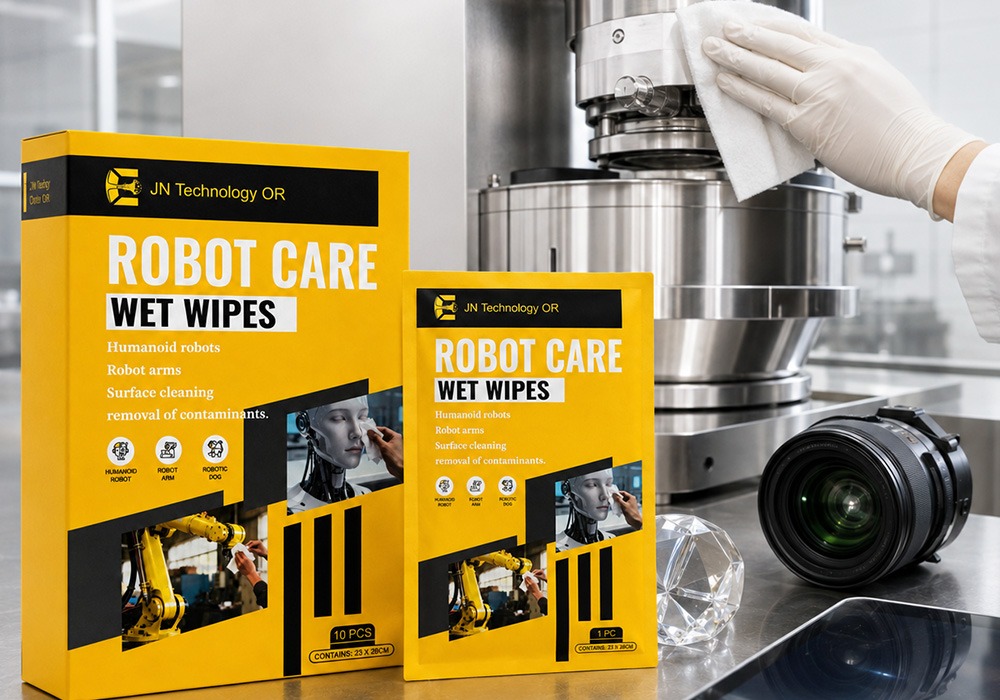
JuNeng Electromechanical’s robotic maintenance wipes are purpose-developed for industrial automation equipment. They come pre-saturated with a specialized cleaning and conditioning formula that removes grease, dust, and light scale in a single step. The wipes feature a thick, low-shedding substrate that is both durable and gentle, ensuring no damage to painted surfaces or optical lenses. Engineered for precise moisture control, they remain damp without dripping, preventing liquid from seeping into sensitive interfaces or crevices. These wipes are ideal for the daily inspection and maintenance of various intelligent systems, including collaborative robots, six-axis robotic arms, AGVs, and sorting robots.

III. Multi-industry application scenarios: Robotic care wipes are increasingly being adopted by maintenance and service teams.

🔹 3C and New Energy Smart Factories: For the numerous collaborative robots and vision-guided sorting robots, pre-shift or daily inspections—including wiping down grippers, camera lenses, and robot housings—help reduce vision-related errors.
🔹 Automotive Parts and Sheet Metal Processing Workshops: In environments heavily exposed to cutting fluids and lubricants, frequent cleaning of robot joints and grippers helps minimize the risk of slippage or mechanical jamming.
🔹 Food and Packaging Automated Production Lines: With food-grade options available, these wipes are ideal for cleaning packaging robots and filling robotic arms, preventing the buildup of grease or debris and ensuring compliance with facility hygiene standards.
🔹 Warehouse and Logistics AGVs: For units operating in dusty warehouse environments, regular cleaning of obstacle-avoidance sensors and the robot chassis ensures reliable navigation and obstacle detection.
🔹 Robotics Service Providers and After-Sales Maintenance Teams: Field technicians can streamline their workflows by carrying a portable pack of wipes instead of multiple oil cans, cleaning agents, and various rags—making maintenance tasks lighter and more efficient.

IV. Tangible Market Dividends: Standardized Maintenance Consumables Help Manufacturing Enterprises Reduce Costs and Increase Efficiency

The upgrade toward intelligent manufacturing has become a major trend. As more factories expand production and add robotic assembly lines, there is a growing, essential demand for standardized, convenient maintenance consumables.
Adopting specialized cleaning wipes for robots offers enterprises several key benefits:

1. Streamlined maintenance processes: Ready to use straight from the pack—no need to mix cleaning agents or prepare various types of cloths. This reduces the time required for individual maintenance tasks, allowing maintenance personnel to oversee a larger number of robots.
2. Reduced risk of malfunctions: Consistent daily cleaning and care help prevent issues such as sensor failures, gripper slippage, and the premature aging of seals, thereby minimizing unplanned downtime.
3. Standardized maintenance protocols: Using the same cleaning wipes across all maintenance stations eliminates the risks associated with individual employees choosing their own cleaning agents or using arbitrary cleaning methods, making it easier for companies to implement standardized SOPs.
4. Simplified procurement and management: With uniform specifications for consumables, bulk purchasing and inventory management become straightforward—an ideal solution for long-term stocking by maintenance or equipment departments.

V. Juneng Electromechanical: Integrated Cleaning and Maintenance Solutions for Precision Equipment

Leveraging its R&D strengths, Juneng Electromechanical offers more than just robotic maintenance wipes; its product portfolio also includes adhesive-removal wipes and firearm-maintenance wipes, addressing the cleaning and care requirements of various specialized equipment. We provide on-site sampling, allowing us to identify the ideal product based on the specific types of industrial grime, robot-casing materials, and optical components involved—thereby preventing equipment damage caused by the selection of unsuitable consumables. We offer reliable supply for a wide range of needs, whether for in-house use by manufacturing plants or for provision to end-users by automation maintenance service providers and system integrators.

In the era of intelligent manufacturing, robots are a factory’s core assets and require meticulous, professional care. Our standardized robotic maintenance wipes simplify complex daily cleaning and upkeep, enabling cost-effective preventive maintenance that ensures the stable operation of automated production lines. If your facility operates a large number of industrial robots, collaborative robots (cobots), or AGVs—and if equipment maintenance is placing a heavy burden on your workforce—please contact Juneng Electromechanical to discover a tailored cleaning and maintenance solution for your robots.